
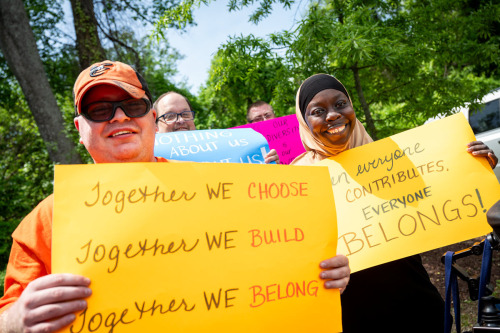
Your vote is your voice, and every voice matters.
At Fello, we believe people with disabilities should have everything they need to vote with confidence. This guide explains your rights and how to get support. It also lists other helpful resources.
Have questions about voting? Email Catherine Kirk Robins, Director of Government Relations, at ckirkrobins@fello.org. If you need help on Election Day, call 1-866-OUR-VOTE (1-866-687-8683).
Why Your Vote Matters
Your vote helps choose leaders for your city, state, and country. These leaders make decisions that can affect your life and your community.
People with disabilities and their allies worked for many years to make voting fair for everyone. Today, the law protects your right to vote.
When people with disabilities vote, leaders pay attention to access. Every vote helps build a community where everyone belongs.
Know Your Rights
Federal and state laws protect your right to vote. You have the right to:
- Access polling places. A polling place is where you vote.
- Use a voting machine that works for you. Every polling place must have at least one machine for people with disabilities.
- Vote by mail. Anyone registered to vote in Maryland can ask for a mail-in ballot.
- Vote without being turned away or treated differently because of your disability.
Things to Know When You Vote in Person
Every polling place has a Ballot Marking Device (BMD). A BMD is a machine that helps you vote. With a BMD, you can:
- Use a touch screen.
- Listen to your ballot through headphones.
- Use keypad buttons to move through the ballot.
- Make the screen easier to see with large print or high contrast.
- Use your own device, like a sip-and-puff system.
Polling places also have other ways to support you.
Getting Around Your Polling Place
Polling places must have ramps, seats, and clear paths. Voting machines must be easy for you to reach.
Getting Support from Poll Workers
Poll workers are trained to help you use the voting machine. You can ask them for other help, too.
Getting Support from Someone Close to You
You can bring someone you trust to help you vote. This can be a friend, a family member, or a Direct Support Professional. You cannot bring your boss or someone from your union. The person who helps you must sign a form that says they are helping you. They cannot tell you how to vote.
What to Do If You Are Told You Cannot Vote
You might be turned away if you are at the wrong polling place or if there is a problem with your registration. If you are not allowed to vote on Election Day, ask the election judge (a poll worker) for a provisional ballot and fill it out.
A provisional ballot is a backup ballot. You use it when there is a question about whether you can vote. It counts only after officials check that you are allowed to vote.
What to Do If You Cannot Get to Your Polling Place
If it is hard for you to get to your polling place, you can ask to vote at a different location. Contact your local board of elections as soon as you can. You can also vote at any early voting center in your county during early voting.
Did you know? If you are in line to vote by 8 p.m. on Election Day, you have the right to vote. If anyone tells you to leave the line before you vote, call 1-866-OUR-VOTE (1-866-687-8683).
Things to Know When You Vote by Mail
You can vote by mail if you do not want to vote in person. Any registered Maryland voter can vote by mail. You do not need a reason.
How to Ask for a Mail-In Ballot
Visit the Maryland Voter Services website to request a ballot. The website will walk you through the steps. You will need an ID to complete the form.
How to Send Back Your Ballot
After you fill out your ballot, you can send it back in one of three ways:
- By mail. Put your ballot in the mail early. The post office stamps the envelope with the date. This stamp is called a postmark. Your ballot must have a postmark of Election Day or earlier. It must also arrive at your local board of elections in time to be counted. The instructions that come with your ballot tell you the last day it can arrive.
- In a drop box. Drop boxes are available all over Maryland. See the list of drop box locations with addresses. Drop off your ballot by 8 p.m. on Election Day.
- In person. Take your ballot to your local board of elections, an early voting center, or your polling place.
You cannot send your ballot by email, fax, or online. Follow the instructions that come with your ballot.
If your ballot arrives late, it will not be counted. A ballot mailed on Election Day might not arrive in time or might not get a postmark that day. If Election Day is near, it is safer to use a drop box.
If You Choose to Always Vote by Mail
If you sign up to always get your ballot by mail, you should not vote in person. If you do vote in person, you will have to fill out a provisional ballot.
How to Print Your Ballot at Home
You can print your ballot at home. After you fill it out, you can mail it, put it in a drop box, or deliver it in person. Maryland has a step-by-step guide to Print-at-Home ballots.
Get Ready for Election Day
Follow these steps to make sure your vote counts:
- Make sure you are registered to vote. Check your registration status.
- Find out early if your polling place is accessible. Look up your polling place. If it is not accessible, you can vote by mail or use the Print-at-Home option before Election Day. These options are not available on Election Day, so plan ahead.
- Learn about the resources available to you. See the websites below.
Election Day Information
Take some time to learn about these resources so you can feel ready to vote.
Maryland State Board of Elections
This website tells you how to register to vote, where to vote, and what support you can get. You can also find a guide on accessible voting.
Call 1-866-OUR-VOTE (1-866-687-8683) if you have a problem when you vote. For example, call if someone treats you unfairly or a voting machine is broken.
Vote411 Maryland and Ballotpedia
These websites list election dates, deadlines, and information about candidates. They are nonpartisan, which means they do not take sides. They can help you find reliable election information.
Check your county’s website for information about your polling place.
Support for People with Disabilities
U.S. Vote Foundation Disability Voting Guide
This guide has tips and steps for voting with a disability.
This group shares information about your rights as a community member, including your rights as a voter.
How to Be an Advocate
Voting is one way to support your community, but it is not the only way. Speaking up for yourself and others can make a difference all year.
Living Boldly from Fello empowers people with disabilities to use their voice, share ideas, and support each other. Anyone with a disability can join, even if they do not receive services from Fello. To learn more or join, email livingboldly@fello.org.
Make Your Vote Count
Elected officials make decisions every day that affect people with disabilities. These decisions can impact health care, transportation, disability services, housing, and more.
Voting helps make sure leaders hear your experiences and understand your needs. Now is your chance to make a change.
Want news about laws, disability rights, and your community? Join Fello’s newsletter. You can also follow us on Facebook, Instagram, and LinkedIn.